Wednesday, May 4, 2016

Exit Interview


(1) What is your essential question, and what are your answers?  What is your best answer and why?
  • How can we maximize player learning experience in educational video games with minimal expense to the entertainment?
    • One of the most crucial methods to ensure an educational game has an enjoyable learning environment is by designing it to have intergenerational gameplay wherein multiple age groups can interact with one another in a positive manner.
    • For the player to gain the most out of their playing experience, a game designer should program their games with an adaptive system so that the player be able to change variables and learn by observing the consequences of their manipulations.
      • Not only is this a well-supported answer, but there is additional benefits of adaptive systems in video games if they were implemented into classrooms. For example, some games can have a function that increases or decreases the difficulty for the game depending on the students' aptitude on the problems. In recording this, teachers will have a good assessment on the students' actually abilities, and students can enjoy a game without the frustration of something being to simple or too challenging.
    • Having a narrative is one of the most essential factors in both the entertainment and educational factors in learning game.
(2) What process did you take to arrive at this answer?
  • In my interviews with Sean Bouchard and Elizabeth Swensen, it so happened that they both mentioned Oregon Trail, a classic game that many deem educational. For this reason, I knew there was some special trait that made Oregon Trail stand out. Bouchard and Swensen were consistent in their praise for the game, which was that it was a game that allowed for much room for manipulation. Depending on the players' abilities and choices, they would go down one of thousands of various branches the game had available, as well as resulting in different endings. Through this, game designers minimize opportunities for players being bored by allowing them to essential do as they please and exploring how their interaction with the game gives them feedback. And, by allowing for much experience to be made by having many pathways for players to go down, players are more likely to understand and learn a concept.
(3) What problems did you face?  How did you resolve them?
  • If I had to be honest, there was a part of me that almost regretted having this as my EQ. I was afraid that I wouldn't find any resources that would gravitate to specific answers, or the answers that I did come up with would lack support. However, I'd later find that my fears were for naught; though it initially seemed there seemed to be no PARTICULAR answer from my research as a whole, once I zeroed in on a seemingly viable response, it turned out to be much easier to find supporting sources now that I knew what to look for.
(4) What are the two most significant sources you used to answer your essential question and why?
  • Hands down, my interviews with my mentors and their colleagues had influenced my answers as well as the entirety of my Senior Project the most. In fact, I would say all the answers were in one way or another rooted to one of the things my mentors had said or done. When I did identify an answer, they helped push me towards sources that would support it, or would validate my answer by giving their own input to it.
  • Several online sources helped, but if I had to decide on one, I'd say that the expert James Paul Gee and his various scattered works on the internet were much help. He was well-versed in both interactive media as well as psycholinguistics, and always strongly elaborated on the connection of learning games and human development.

Thursday, April 21, 2016

Blog 22: Independent Component 2

LITERAL

  • I, Jessica Bui, affirm that I completed my independent component which represents 44 hours of work.
  • Cite your source regarding who or what article or book helped you complete the independent component.
I would not be here without the help of my mentors, Sean Bouchard, Elizabeth Swensen, and Tracy Fullerton. However, if I were to get into specifics, they helped me by playtesting my game as it was in progress and offered me very valuable feedback to improve the playability of it. For example, in regards to one of the puzzles I programmed, he had a lot of trouble trying to solve it without my frequent input. When he was first playing it, he thought the unknown symbols on the whiteboard were supposed to represent various times of the analog clock).

In addition, I had a phenomenal amount of help from a variety of admittedly faceless people on the RPG Maker forum website, which can be accessed here; http://forums.rpgmakerweb.com/ It helped me learn and solve a variety of things to put into my game. It would be impossible to compile all the work I had relied on throughout my independent component, but some examples I have involve me unlocking doors and overlay mapping (a form of mapping in RPG Maker software).

  • Update your Independent Component 2 Log (which should be under your Senior Project Hours link)
Swagger my dagger. Here it is.
  • Explain what you completed.    
"Completed" is a stretch to describe the state of my IC #2, but I would confidently say that I did beyond the 30 hours I was required. My first IC was the game design/game plan to design a game in the RPG Maker, and my IC #2 was basically putting that plan into that motion. Using mostly RPG Maker VX Ace the game-making software, as well as Photoshop CS3 portable, I've been making a RPG 16-bit game that is set on I-Poly. The narrative of the story revolves around a protagonist who is suffering from depression, and goes through a journey in an alternate, darker version of I-Poly dubbed as "the Vale" where they must get back to their own world. Through their journey, they will meet several people and endure several puzzles that will eventually help strengthen them. A lot of the time spent on this revolves around editing the classrooms and programming the puzzles.

  • Defend your work and explain the component's significance and how it demonstrates 30 hours of work. Provide evidence (photos, transcript, art work, videos, etc) of the 30 hours of work.   
While I may not have finished the game entirely YET, the amount of time and effort I have expended in this project is without a doubt an enormous endeavor I have done this year. I hope that the fact that it has yet to be incomplete in no way detracts the value of it as an Independent Component that was supposed to be finished. I've spoken to Mr. Rivas if it would be alright for me to continue on it after the IC #2 deadline, considering I have indeed spent over 30 hours on it already. With that said, I would love to show the progress of my work!

- Before I even went off to the other puzzle, I edited the currently existing "Look-and-Say" Puzzle. Before, it looked like this (which I made in my IC #1):


This is very inaccurate, but at the time the boards in the actual game were chalkboards. However, I was able to invert the colors and make it seem just like a whiteboard. The next step was to actually make a picture with this. I decided to find a photo of a plain whiteboard on Google images, which is shown below.


Because this is a horror game, and will most definitely be set in a room that has dim lighting (for atmosphere), I decided to similarly dim the brightness of the image on Photoshop, and I drew the "riddle" again on the whiteboard. Now, it looks like it could even pass for a real photo.


The following are the freshman classes in the RPG Maker game. They are Estrada, Cancino, Pelligrini, and Strand's respectively.


In Estrada's class, here's how I coded the puzzle to work, as well as how I coded the filing cabinet


Though these lines don't appear to take long to code it takes an extremely a long amount of time to playtest them to get them to accurately do what they want. These don't even scratch the surface to the amount of coding it takes, considering there are several Conditional Switches and Branches that are involved and connected to other "events" in the video game.

I mention in my IC #2 log that I wanted the puzzle to involve... a surprise. The player needs to know that one of the clues to solving the puzzle is the number "10". However, unlike the other number clues which are obvious, the "10" clue is conveyed through a picture I drew on Photoshop. I tried my best to make it creepy, but I think I ended up making it too cliche.


I really needed a break from the programming, so I decided to finally focus on the artistic parts of the game, including the portraits. I wanted for the characters to interact Fire Emblem style, with busts as opposed to small portraits. Unfortunately, after spending much time on the bust, I realized that it was too time-consuming, and I've yet to get a grasp on panting on Photoshop. But here is how the bust would've looked like:


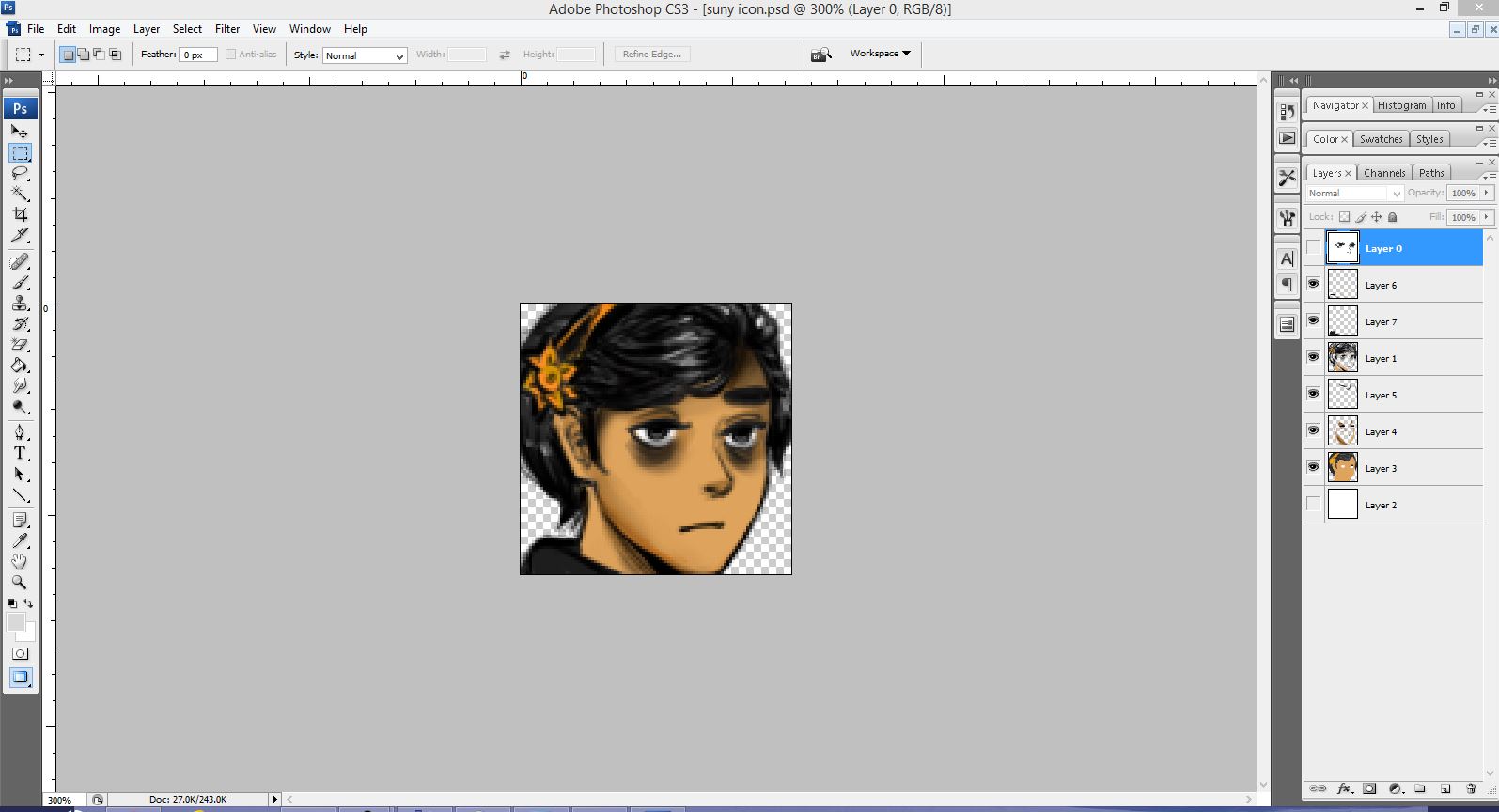
Again, I was like "Nah." So I decided to just go with the in-built 96x96 pixel portrait function in the RPG Maker. The following are a couple of phases of me drawing and coloring. 
 (I realized that the photo was too close to the face, obscuring even the chin. I edited it a little more so that it's properly spaced. The following is the final face portrait that will be in the final version of the game:)


  • How did the component help you answer your EQ? Please include specific examples to illustrate how it helped. 

In the USC game design program, it's a common saying that the game designer is an advocate for the player. What this means is that the game designer's priorities are always the experience of the people who are meant to play their product. In making this game, I was able to go through several steps of real game designers, including the iteration process and research. Though it may seem like just a horror game with a twist of real-life, this game is considered educational in that it's meant to help players better understand mental illness, particularly depression, generalized anxiety disorder, obsessive compulsive disorder, and bipolar disorder. However, in order to get an accurate representation of how a person experiences the aforementioned mental illnesses, I not only did research on accounts of those who have them, but I also consulted others I know personally who have them.

In particular, this project had helped me answer my EQ by making me realize some facts that would eventually become my third EQ answer, which is that storytelling is an effective method for players to retain the information being conveyed in learning games in a meaningful way. We feel more in tune with the main character because we've connected with them, and therefore feel more closely with the things they experience. The player will therefore be more emotionally attached, especially because this character is literally a student of I-Poly (and the target audience for this video game are I-Poly attendees). They become more relatable.

Thursday, March 10, 2016

Fourth Interview Questions


1.  Who do you plan to interview?  What is this person's area of expertise?

My other mentor, Sean Bouchard, is a possible candidate for my interview. I've yet to interview him, but it would be sensible to choose him since he specializes in educational games. I haven't cemented who I will be interviewing yet.

2.  Post 20 open-ended questions you want to ask an expert in the field concerning your senior project. Your focus should be finding answers to your EQ.


1. What is a common theme you find in good learning games?
2. What aspects of a learning game do you find the most important in the design process?
3. What common flaws do you find in learning games?
4. How do you try to avoid making a boring educational game?
5. What is the most difficult part in designing educational video games?
6. Why did you decide to specialize in this area?
7. What is your particular design process when making video games?
8. When commissioned/granted to make a learning game of a subject you aren't familiar with, how do you go about it?
9. What are some examples of your favorite effective learning games?
10. Where do you draw most of your inspiration from when making educational video games?
11. Some might think that educational video games are somewhat rigidly-structured. How do you incorporate your creativity into it?
12. What do you say is easy about making educational video games (relatively speaking)?
13. What do beginning game designers tend to do (flaws or strengths)?
14.  How to you ensure your educational game is unique and not a glorified test?
15. My independent component is about teaching and giving awareness about mental illnesses. What is your advice on how I've approached it so far?
16. Straightforward: how do YOU think we should maximize player learning experience with minimal expense to the entertainment?
17.  What sources do you recommend I look into for my Senior Project topic?
18.  If you could turn back time to when you were first starting out, what would you do differently in your work in this field? (Basically, what are your regrets?)
19. What advice do you have for aspiring game designers, whether or not their focus is educational? 
20. What are you most proud of in your own learning games that you have made? Do you have one project you are most proud of?


Wednesday, March 2, 2016

Blog 19: Third Answer


1. EQ:
How can we maximize player learning experience in educational video games with minimal expense to the entertainment? 

2. Answer #3: 
Having a narrative is an essential factor to the both the entertainment and effectiveness of an educational/learning game.

3. 3 details to support the answer:

- Narratives give the emotional glue that connects the audience to the message. Much of what people remember from a learning experience are the feelings of the underlying message rather than a multitude of small facts (which are better reserved for job aids).
- Stories motivate target audiences toward learning goals. They are also ideal for attitudinal training because when an audience is motivated, they no longer need to be persuaded. An encouraging story will inspire someone to take action. Motivation is one the top of the list of "important factors" in making educational video games successful.
- Storytelling offers a cognitive frame for reflecting experiences and activities being done by the player, thus making things easier to comprehend while adding an entertaining dimension to the game.

4. The research source(s) to support your details and answer:
http://www.hindawi.com/journals/ijcgt/2015/549684/ 
http://theelearningcoach.com/elearning2-0/why-you-need-to-use-storytelling-for-learning/ 
http://www.narratology.net/sites/www.narratology.net/files/ENN%202011%20Sanna-Mari%20%C3%84yr%C3%A4m%C3%B6%20-%20Narrative%20in%20Serious%20or%20Learning%20Game%20Design%20Reseach.pdf 

5. Concluding Sentence:

Stories were the building blocks of childhoods, and are some of the things we remember most; they are tools that we should not take for granted, and educational video games would do well in taking advantage of them.


Tuesday, February 23, 2016

Blog 18: Answer 2


1.  What is your EQ?
How can we maximize player learning experience in educational video games with minimal expense to the entertainment? 

2.  What is your first answer? 

One of the most crucial methods to ensure an educational game has an enjoyable learning environment is by designing it to have intergenerational gameplay wherein multiple age groups can interact with one another in a positive manner.

3.  What is your second answer?

For the player to gain the most out of their playing experience, a game designer should program their games with an adaptative system so that that the player be able to change  variables and learn by observing the consequences of their manipulations.

4.  List three reasons your answer is true with a real-world application for each.


-  Oregon Trail would hardly be compelling if it didn’t matter whether you had more doctors than farmers on board, or began with 50 or 30 pounds of food. Part of what makes the game entertaining is that players get to observe what happens if they tinker with the variables. Not only is this fun (because you get to make decisions), but it also encourages systemic thinking, which is at the heart of productive cognitive work.

- In my most recent interview with my mentor, I had gotten this answer: In terms of the actual gameplay of a game for learning, an educational game is better when there is no obvious right and wrong answer as there might be on something in a quiz. Rather, the game gives a range of variables the player can mess with and, through the consequences and changes that they experience, understand the system through that.

- In Feed the Fox, a game prototype developed by Muzzy Lane and Knewton, students construct food webs in various biomes to learn about species classification, the environmental pressures different biomes present, and how organisms are related in an ecosystem. Each student action in the game gives Knewton a hint about one, or perhaps several, of her conceptual understandings (or misunderstandings).

5.  What printed source best supports your answer?


http://venturebeat.com/2015/06/24/making-educational-games-is-tough-especially-if-you-want-to-make-money/

6.  What other source supports your answer?

http://public.psych.iastate.edu/caa/abstracts/2005-2009/08SA.pdf 
http://www.teachingliterature.org/teachingliterature/pdf/media/video_games_metaphor_dubbels.pdf
https://www.knewton.com/resources/blog/ed-tech/educational-game-1/
http://edepositireland.ie/bitstream/handle/2262/39164/Adaptive%20Educational%20Games%20-%20Providing%20Non-invasive%20Personalised%20Learning%20Experiences.pdf?sequence=1&isAllowed=y
https://www.knewton.com/resources/blog/adaptive-learning/adaptive-learning-and-game-content-bridging-gaps-to-engage-students-2/

7.  Tie this together with a concluding thought.


We learn best not by getting things correct, but by making mistakes. Video games allow free range of possibilities that would be harder to achieve in real life. We can learn more with video games by taking advantage of the idea that video games can act as a "sandbox" and we can learn the consequences without experiencing the consequences of things.


Wednesday, February 17, 2016

Blog 17 - Interview 3 Reflection


(Click Image to listen to Interview 3)

1. What is the most important thing I learned from the interview?  


Without a doubt, discovering that educational games - or, as my mentor puts it, games for learning - aren't limited to curricular subjects has been very important thus far. I honestly feel ridiculous for not having realized this sooner, especially since it seems like an intuitive thing to pick up. To some degree, I DID know this, but I never realized how this knowledge could have helped me for my Independent Component. 

As I was completing the pre-production for my video game in my IC1, I had settled for having the educational aspects in the game be put in the 16 puzzles that are intended to be in the game. However, I couldn't help that, in a very distant but still connectable way, this was basically another setup for a "glorified quiz"; there were basically 16 questions, with 4 for each core subject (Math, English, Sciences, Social Sciences). When I said that I wanted this to be a puzzle-horror game, my true vision for the game was to have the 16 puzzles to be ACTUAL puzzles - critical thinking problems, riddles, unconventional problem-solving that can be artistic or downright gruesome. However, I also wanted to educate something (hence it being an educational game), so I thought I should settle by having each puzzle in each of the 16 classrooms simply be a problem that is related to its respective classroom (for example, in Estrada's class, the "puzzle" will be a problem that must be solved using basic algebra). I couldn't help but feel unsatisfied by this, because it felt almost like a sort of rushed addition to make it into a game. 

But it never occurred to me that not all educational games have to be curricular. They can teach a concept, and or situation. 

That's where this comes into play: in addition, the actual narrative of the game had taken a direction that I didn't initially intend, which was addressing mental illness. The main character, Sunny, will be revealed to suffer from depression, and this in itself is one of the factors that fuels the nightmarish environment our protagonist must endure for most of the game. 

Everything in the game will remain the same in terms of my IC1 and IC2. In fact, surface-wise, nothing has changed. But I have a much more defined and uniform objective now. I'm no longer constrained in making the levels/puzzles mere conventional word-problems, but actual puzzles like I originally wanted.  Moreover, my goal now will be to handle the addressing of mental illness more carefully in the game now; rather than it be a type of plot device, it will actually be essential to the underlying message. Mental illness is often faced with a lot of misunderstanding, but I have friends who battle with it constantly, and I think it would be good if this game's goal was to educate people about misconceptions about depression. 

2.  How has your approach to interviewing changed over the course of your senior project?


I have been much more at ease in my interviews, especially compared to my first one. This recent interview was unintentionally the longest out of all the ones I've conducted, but it had been done so out of sheer engagement with my mentor's wisdom. Especially because we have much more freedom with the questions, I feel more open in asking what I need from my mentor. It's also helped by the fact that, whereas in my previous interviews I was doing general researching, this interview had a much more clear goal, which was to research for my EQ.

Tuesday, February 9, 2016

Blog 16: Independent Component 2 Approval


1.  Describe in detail what you plan to do for your 30 hours.
Independent Component 1 was essentially the Phase 1 of my video game project; it was the general blueprint of everything without actually making the game itself (except for the digital prototypes). My proposal for IC 2, on the other hand, will be putting all that planning into motion and actually developing the game. I will be refining and inputting the dialogue into the actual project, produce the art that will come in the game, arrange the public-domain music in the game (I can't compose music or play an instrument), program the events that will occur in the game, and ultimately end up with a fully functioning game that an individual I-Poly student can play. I can definitely tell that this will be a arduous process that will be much longer than my first IC, but it's one I'm genuinely excited about and will have no qualms doing even 60 hours for. I have already produced the digital prototypes, which will give an idea of what the game will be like.

2.  Discuss how or what you will do to meet the expectation of showing 30 hours of evidence.
Similar to how I did IC 1, I'm planning to take photos of my physical work (sketches, prototypes, etc.) and screenshots of my digital work (such as the actual programming of the game). Now that I have the software, I might even record my desktop directly for intervals at a time as I'm working. When I am content with the game, it will be published for anyone at I-Poly to play. That in itself will also be a testament to the hours I spent on it.

3.  Explain how this component will help you explore your topic in more depth.

This game, as I have outlined before, is meant to be a horror-puzzle game intended to teach basic educational concepts. I want to make a very simple educational game basically that will be accompanied by a dramatic narrative. Of course, I'm not just going to be programming them immediately. I will playtest the games with people to see if I am achieving the right reactions from the players. The playtesting and iteration are all part of the development process as well. While I will definitely be receiving feedback from peers and external sources, I'm generally going to be acting as a one-person game developer. This experience is going to be more experiential than my previous IC, which was more research-based. This will give me insight on the inner machinations of a game designer, from their 

4.  Post a log in your Senior Project Hours link and label it "Independent Component 2" log.


Yes. Alright. Affirmative. Roger that. Copy. Ok. 
Here: https://docs.google.com/spreadsheets/d/1YuoVImM4-UA4vKrLTj_diY75B4dhf4R3oh6keFVh8nM/edit?usp=sharing