Showing posts with label Independent Component. Show all posts

Thursday, April 21, 2016

Blog 22: Independent Component 2

LITERAL

  • I, Jessica Bui, affirm that I completed my independent component which represents 44 hours of work.
  • Cite your source regarding who or what article or book helped you complete the independent component.
I would not be here without the help of my mentors, Sean Bouchard, Elizabeth Swensen, and Tracy Fullerton. However, if I were to get into specifics, they helped me by playtesting my game as it was in progress and offered me very valuable feedback to improve the playability of it. For example, in regards to one of the puzzles I programmed, he had a lot of trouble trying to solve it without my frequent input. When he was first playing it, he thought the unknown symbols on the whiteboard were supposed to represent various times of the analog clock).

In addition, I had a phenomenal amount of help from a variety of admittedly faceless people on the RPG Maker forum website, which can be accessed here; http://forums.rpgmakerweb.com/ It helped me learn and solve a variety of things to put into my game. It would be impossible to compile all the work I had relied on throughout my independent component, but some examples I have involve me unlocking doors and overlay mapping (a form of mapping in RPG Maker software).

  • Update your Independent Component 2 Log (which should be under your Senior Project Hours link)
Swagger my dagger. Here it is.
  • Explain what you completed.    
"Completed" is a stretch to describe the state of my IC #2, but I would confidently say that I did beyond the 30 hours I was required. My first IC was the game design/game plan to design a game in the RPG Maker, and my IC #2 was basically putting that plan into that motion. Using mostly RPG Maker VX Ace the game-making software, as well as Photoshop CS3 portable, I've been making a RPG 16-bit game that is set on I-Poly. The narrative of the story revolves around a protagonist who is suffering from depression, and goes through a journey in an alternate, darker version of I-Poly dubbed as "the Vale" where they must get back to their own world. Through their journey, they will meet several people and endure several puzzles that will eventually help strengthen them. A lot of the time spent on this revolves around editing the classrooms and programming the puzzles.

  • Defend your work and explain the component's significance and how it demonstrates 30 hours of work. Provide evidence (photos, transcript, art work, videos, etc) of the 30 hours of work.   
While I may not have finished the game entirely YET, the amount of time and effort I have expended in this project is without a doubt an enormous endeavor I have done this year. I hope that the fact that it has yet to be incomplete in no way detracts the value of it as an Independent Component that was supposed to be finished. I've spoken to Mr. Rivas if it would be alright for me to continue on it after the IC #2 deadline, considering I have indeed spent over 30 hours on it already. With that said, I would love to show the progress of my work!

- Before I even went off to the other puzzle, I edited the currently existing "Look-and-Say" Puzzle. Before, it looked like this (which I made in my IC #1):


This is very inaccurate, but at the time the boards in the actual game were chalkboards. However, I was able to invert the colors and make it seem just like a whiteboard. The next step was to actually make a picture with this. I decided to find a photo of a plain whiteboard on Google images, which is shown below.
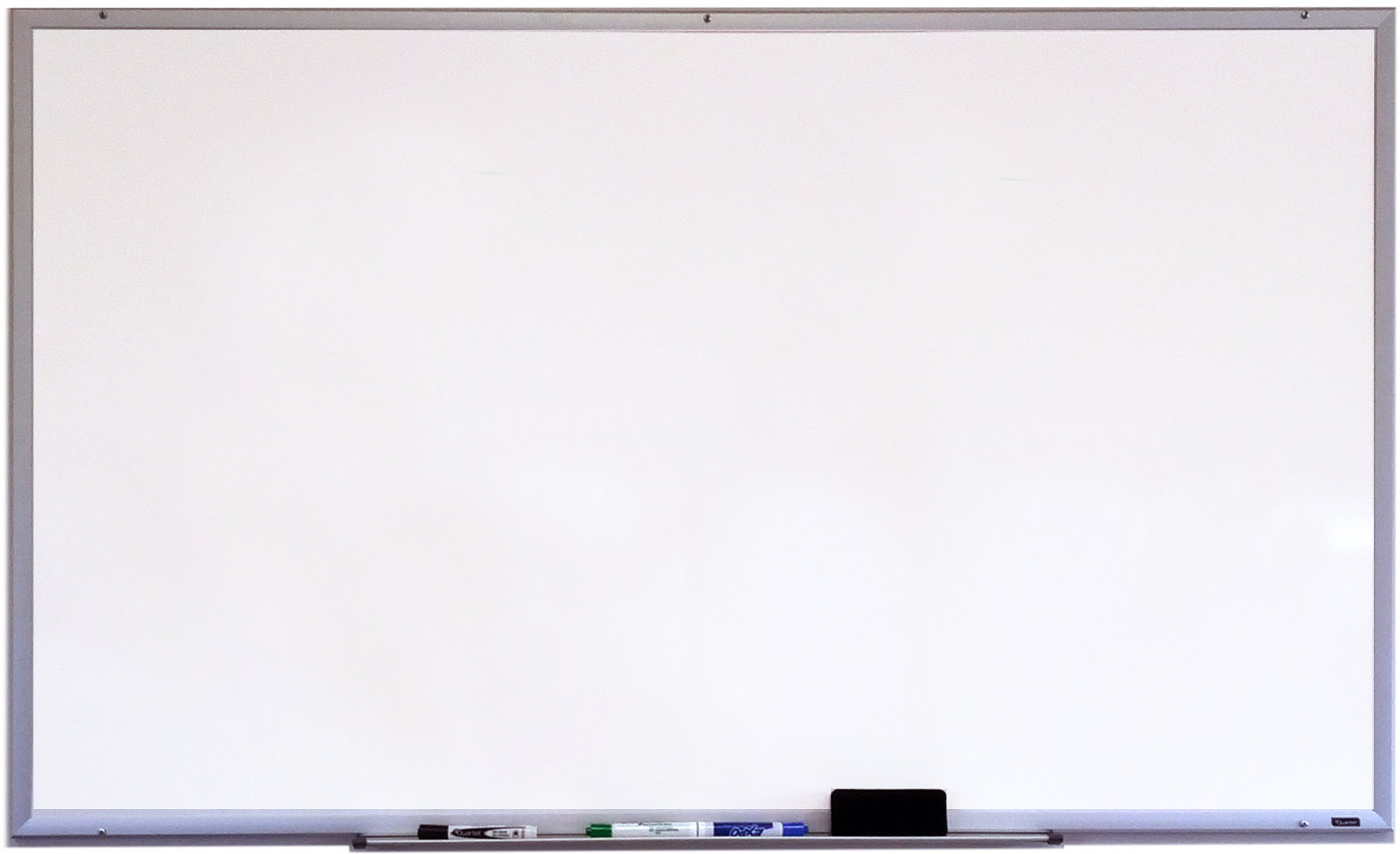


Because this is a horror game, and will most definitely be set in a room that has dim lighting (for atmosphere), I decided to similarly dim the brightness of the image on Photoshop, and I drew the "riddle" again on the whiteboard. Now, it looks like it could even pass for a real photo.


The following are the freshman classes in the RPG Maker game. They are Estrada, Cancino, Pelligrini, and Strand's respectively.


In Estrada's class, here's how I coded the puzzle to work, as well as how I coded the filing cabinet


Though these lines don't appear to take long to code it takes an extremely a long amount of time to playtest them to get them to accurately do what they want. These don't even scratch the surface to the amount of coding it takes, considering there are several Conditional Switches and Branches that are involved and connected to other "events" in the video game.

I mention in my IC #2 log that I wanted the puzzle to involve... a surprise. The player needs to know that one of the clues to solving the puzzle is the number "10". However, unlike the other number clues which are obvious, the "10" clue is conveyed through a picture I drew on Photoshop. I tried my best to make it creepy, but I think I ended up making it too cliche.


I really needed a break from the programming, so I decided to finally focus on the artistic parts of the game, including the portraits. I wanted for the characters to interact Fire Emblem style, with busts as opposed to small portraits. Unfortunately, after spending much time on the bust, I realized that it was too time-consuming, and I've yet to get a grasp on panting on Photoshop. But here is how the bust would've looked like:


Again, I was like "Nah." So I decided to just go with the in-built 96x96 pixel portrait function in the RPG Maker. The following are a couple of phases of me drawing and coloring. 
 (I realized that the photo was too close to the face, obscuring even the chin. I edited it a little more so that it's properly spaced. The following is the final face portrait that will be in the final version of the game:)


  • How did the component help you answer your EQ? Please include specific examples to illustrate how it helped. 

In the USC game design program, it's a common saying that the game designer is an advocate for the player. What this means is that the game designer's priorities are always the experience of the people who are meant to play their product. In making this game, I was able to go through several steps of real game designers, including the iteration process and research. Though it may seem like just a horror game with a twist of real-life, this game is considered educational in that it's meant to help players better understand mental illness, particularly depression, generalized anxiety disorder, obsessive compulsive disorder, and bipolar disorder. However, in order to get an accurate representation of how a person experiences the aforementioned mental illnesses, I not only did research on accounts of those who have them, but I also consulted others I know personally who have them.

In particular, this project had helped me answer my EQ by making me realize some facts that would eventually become my third EQ answer, which is that storytelling is an effective method for players to retain the information being conveyed in learning games in a meaningful way. We feel more in tune with the main character because we've connected with them, and therefore feel more closely with the things they experience. The player will therefore be more emotionally attached, especially because this character is literally a student of I-Poly (and the target audience for this video game are I-Poly attendees). They become more relatable.

Tuesday, February 9, 2016

Blog 16: Independent Component 2 Approval


1.  Describe in detail what you plan to do for your 30 hours.
Independent Component 1 was essentially the Phase 1 of my video game project; it was the general blueprint of everything without actually making the game itself (except for the digital prototypes). My proposal for IC 2, on the other hand, will be putting all that planning into motion and actually developing the game. I will be refining and inputting the dialogue into the actual project, produce the art that will come in the game, arrange the public-domain music in the game (I can't compose music or play an instrument), program the events that will occur in the game, and ultimately end up with a fully functioning game that an individual I-Poly student can play. I can definitely tell that this will be a arduous process that will be much longer than my first IC, but it's one I'm genuinely excited about and will have no qualms doing even 60 hours for. I have already produced the digital prototypes, which will give an idea of what the game will be like.

2.  Discuss how or what you will do to meet the expectation of showing 30 hours of evidence.
Similar to how I did IC 1, I'm planning to take photos of my physical work (sketches, prototypes, etc.) and screenshots of my digital work (such as the actual programming of the game). Now that I have the software, I might even record my desktop directly for intervals at a time as I'm working. When I am content with the game, it will be published for anyone at I-Poly to play. That in itself will also be a testament to the hours I spent on it.

3.  Explain how this component will help you explore your topic in more depth.

This game, as I have outlined before, is meant to be a horror-puzzle game intended to teach basic educational concepts. I want to make a very simple educational game basically that will be accompanied by a dramatic narrative. Of course, I'm not just going to be programming them immediately. I will playtest the games with people to see if I am achieving the right reactions from the players. The playtesting and iteration are all part of the development process as well. While I will definitely be receiving feedback from peers and external sources, I'm generally going to be acting as a one-person game developer. This experience is going to be more experiential than my previous IC, which was more research-based. This will give me insight on the inner machinations of a game designer, from their 

4.  Post a log in your Senior Project Hours link and label it "Independent Component 2" log.


Yes. Alright. Affirmative. Roger that. Copy. Ok. 
Here: https://docs.google.com/spreadsheets/d/1YuoVImM4-UA4vKrLTj_diY75B4dhf4R3oh6keFVh8nM/edit?usp=sharing 


Thursday, February 4, 2016

Independent Component 1


LITERAL
  •  I, Jessica Bui, affirm that I completed my independent component which represents 35 hours of work.
  • The sources that primarily helped me in my independent component were the textbook Game Design Workshop: A Playcentric Approach to Creating Innovative Games by Tracy Fullerton, which explained to me the iteration process of game design as well as the Game Design Log from Lost Garden (http://www.lostgarden.com/2011/05/game-design-logs.html), which largely influenced how I documented/compiled my work. The video tutorials on how to work the software RPG Maker VX Ace by the Youtuber Novem also helped me grasp the basics on how I made my digital prototypes (maps). 
  • See here for Hours
  • In the amount of hours that I have worked on my Independent Component, I have basically gotten down the pre-production on the game I play to fully create in my second IC. I looked at Tracy Fullerton's iteration process in her book to determine what information I would be putting down in my document, such as story, premise, characters, physical prototyping, digital prototyping, and player experience goals. My time working on the project consists of mostly working on the computer. I also made sure to add artwork, as well as a video tour for what I had of the digital prototype thus far.
INTERPRETIVE 
  • This Independent Component has truly allowed to me to have a deeper experience in understanding what it's like to be a game designer, even an amateur one. By taking on this project, I had not only assigned myself as the game designer, but also the creative director, writer, artist, and programmer. The majority of my time was spent on the digital prototyping, and the second most of my time was spent on the writing/narrative of the game, which is significant to my vision of the game. I have many drafts that do not even make it to the Game Design Document because they are mostly repetitions with minor tweaking.
  • Evidence: Game Design Document and RPG I-Poly Campus Digital Prototype Tour
APPLIED
  • Thanks to this IC, I understood that, despite being basically the sole creator of the game at first, collaboration and input from others is extremely important. Game design, as is any form of design, is a largely creative field, and when it comes to making art, there will be times you will have to weigh on whether you should pursue a decision as the independent hand of the project or actively take into the consideration of others. Many of my decisions in the game were heavily influenced by three of my supportive friends in this project, such as character design and certain sensitive subjects that will be in the game. Nevertheless, I have realized that the design of the game has become much better than if I had decided to simply worked on it without bothering to show others.

Wednesday, October 7, 2015

Blog 8: Independent Component 1 Proposal


1.  Describe in detail what you plan to do for your 30 hours.


Just as there are for books, films, and even architecture, there is a pre-production for video games, which is exactly want I want to focus on for my first independent component. Pre-production in video games is where the concept development and design - storyline, mood boards, characters - take root so that a interactive medium may grow into a full-fledged game, however simple it may be. Since the start of senior year, I have been wanting to dive into the process of making a video game using the RPGMaker software my brother had given me, but thanks to my mentorship and research that Senior Project entails, I have back-pedaled to realize that there is much more than just coding the game with the software; video games games, throughout modern history, has evolved beyond just Pong and mechanics to entertain the player. Our standards have been raised to the point where video games can pass as an artistic medium.


I want to understand the experience of this creative aspect of game design, where brainstorming is the default state of mind and the most spontaneous ideas have potential. I want to make this component so that, by the end, I have a detailed outline that will be ready to accompany me in the actual production process when that time comes. Of course, in this aspect of game design, there are certain things that must primarily be tackled.

The following is what I want to accomplish:
- Storyline: What is the plot of the game, and what are the lessons and themes that will play throughout with the player?
- Map outlines: I will sketch out and design a virtual recreation of the I-Poly campus, to which the game will be based on.
- Mood boards: Because I want the game to be of the puzzle-horror genre, what filters/mechanics can I use to maximize this experience? 
- Puzzles: The game is going to be designed so there are 16 main puzzles, 1 per core classroom the the virtual I-Poly setting. This will also connect to the plot.
- Character designs: I definitely want the character to be fictional, so they will have a customized sprite as well as portrait to accompany the player all the way through.
- Audio distribution: An essential to ever horror game is the use of sounds. At my disposal are public domain audio clips. How can I use them to maximize the player experience in a horror setting?

All of this will be compiled into a Game Design Document (GDD).

Thanks to my mentor's textbook, Game Design Workshop, I have actually found a proper description and process in which I plan to execute this independent component. In the book, it's known as the Brainstorming and Physical Prototype steps in the process known as Iteration (the design, test, and evaluation of the game-making). Brainstorming simply refers to setting the player experience goals, deciding in what game concepts we want inside of the game.

2.  Discuss how or what you will do to meet the expectation of showing 30 hours of evidence.

This process will take a myriad of media: text for the storyline and plan for audio distribution, graph paper for the map outlines, and sketches/drawings for the mood boards, puzzles, and character designs. Each and everyone can be documented by either photos or screenshots. I will spend a certain amount of time in a given day, which will help me in my documentation of my hours. Each one is a small endeavor; there are 6 sections total. It is a pretty safe bet to say that each aspect will take an average of 5 hours to complete, and the compilation make take extra time.

3.  Explain how what you will be doing will help you explore your topic in more depth.

As mentioned before, game design has a great potential in society as an interactive, immersive medium. That is not to say that there aren't just games that are designed solely as brain-candy and are built to entertain, but there is a pool in the game industry that also tries to work beyond that. For me, I want to have an experience, even if it is that of a beginner, in designing video games. It is no different from someone who plans out a book, a movie, or even a building. There is so much behind the many products in our world, and creating a GDD will definitely serve as proof of that. Many memorable aspects of video games all are somehow derived from an idea that was made in pre-production, and that process is something I am deeply interested in.
4.  Update your Senior Project Hours log.

Check the link on the sidebar! It has been updated.